How Much Income Do You Need to Buy a Home in Canada in 2026? City-by-City Breakdown

By Canooq Editorial
May 28, 2026
See the estimated income needed to buy a median-priced home in major Canadian cities in 2026, including Vancouver, Toronto, Calgary, Montreal, Edmonton, Winnipeg, Quebec City and more.

What's on this page
A practical 2026 city-by-city guide to the income buyers need to purchase a median-priced home in Canada, based on mortgage rate, down payment and housing-cost assumptions.
Buying a home in Canada in 2026 is still heavily shaped by where you live. A household that may be close to qualifying in Saint John, Thunder Bay or Saguenay could be hundreds of thousands of dollars away from qualifying for a median-priced home in Vancouver or Toronto. The national number is useful, but it hides a huge gap between Canada’s most expensive housing markets and its more affordable regional cities.
Based on the chart below, buyers in Canada need an estimated $109,000 in annual household income nationally to buy a median-priced home. The calculation uses a 20% down payment, an average 5-year fixed mortgage rate of 4.5%, and assumes buyers spend no more than 30% of gross annual income on housing costs, including property taxes and insurance. The data is presented as being based on CREA, Ratehub and Statistics Canada data.
That means this article is not saying every buyer with this exact income will automatically qualify. Mortgage approval also depends on your debts, credit score, down payment source, property type, heating costs, condo fees, lender rules and the mortgage stress test. CMHC explains that mortgage professionals use Gross Debt Service and Total Debt Service ratios to assess affordability, with common guideline limits of 39% for GDS and 44% for TDS. OSFI’s current minimum qualifying rate for uninsured mortgages is the greater of the mortgage contract rate plus 2 percentage points or 5.25%, which means many borrowers must qualify at a higher rate than the rate they actually pay.
Income needed to buy a home in Canada by city in 2026
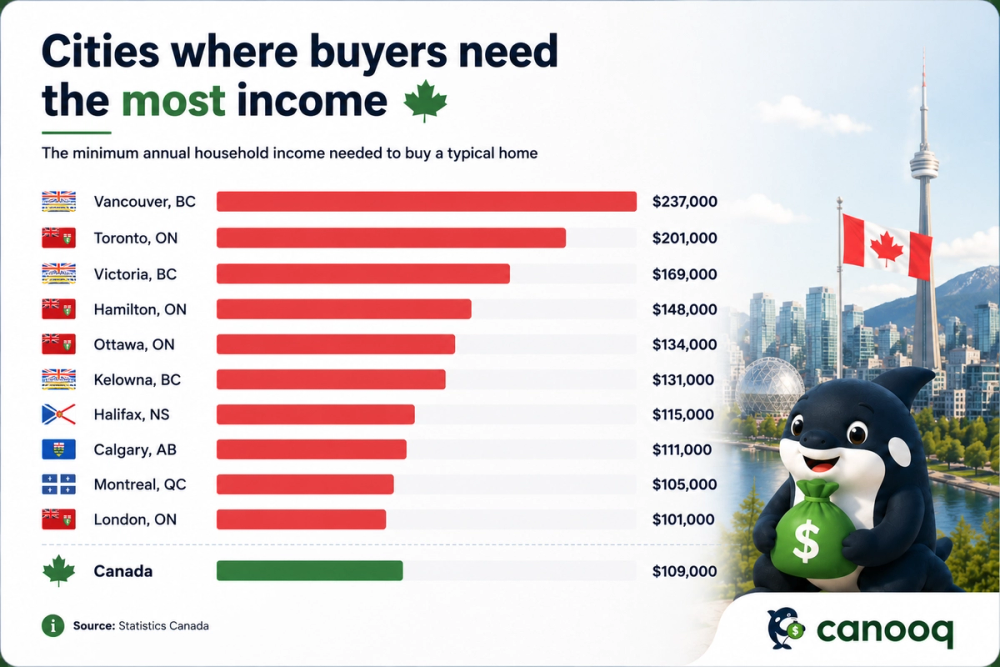
The most expensive markets are not surprising. Vancouver and Toronto remain in a category of their own, with Victoria, Hamilton and Ottawa also requiring significantly more income than the national estimate. In the source chart, the highest-income markets are concentrated in British Columbia and Ontario, with Halifax and Calgary also appearing above the national benchmark.
- Vancouver, BC: $237,000
- Toronto, ON: $201,000
- Victoria, BC: $169,000
- Hamilton, ON: $148,000
- Ottawa, ON: $134,000
- Kelowna, BC: $131,000
- Halifax, NS: $115,000
- Calgary, AB: $111,000
- National: $109,000
- Montreal, QC: $105,000
- London, ON: $101,000
The first thing to notice is how quickly affordability changes once you cross the Vancouver and Toronto line. Vancouver’s estimated income requirement of $237,000 is more than double the national estimate of $109,000, while Toronto’s estimated requirement of $201,000 is also far above what many dual-income households earn. These numbers help explain why many buyers in those markets rely on larger down payments, family support, condo purchases, longer timelines or moves to surrounding cities.
Victoria, Hamilton, Ottawa and Kelowna sit in the middle of the expensive-market group. They may look cheaper than Vancouver and Toronto, but they still require estimated household incomes between $131,000 and $169,000. For many buyers, that means affordability depends less on the sticker price alone and more on whether they have already built a large down payment, avoided high monthly debts and kept enough room for closing costs.
Calgary, Halifax, Montreal and London are closer to the national estimate, but they are not automatically “cheap.” Calgary’s estimated income requirement is $111,000, Halifax is $115,000, Montreal is $105,000, and London is $101,000. In practical terms, these cities may be more accessible than Vancouver or Toronto, but a buyer still needs strong income, clean debt ratios and enough savings to handle costs beyond the down payment.
Cities where buyers need the least income in 2026
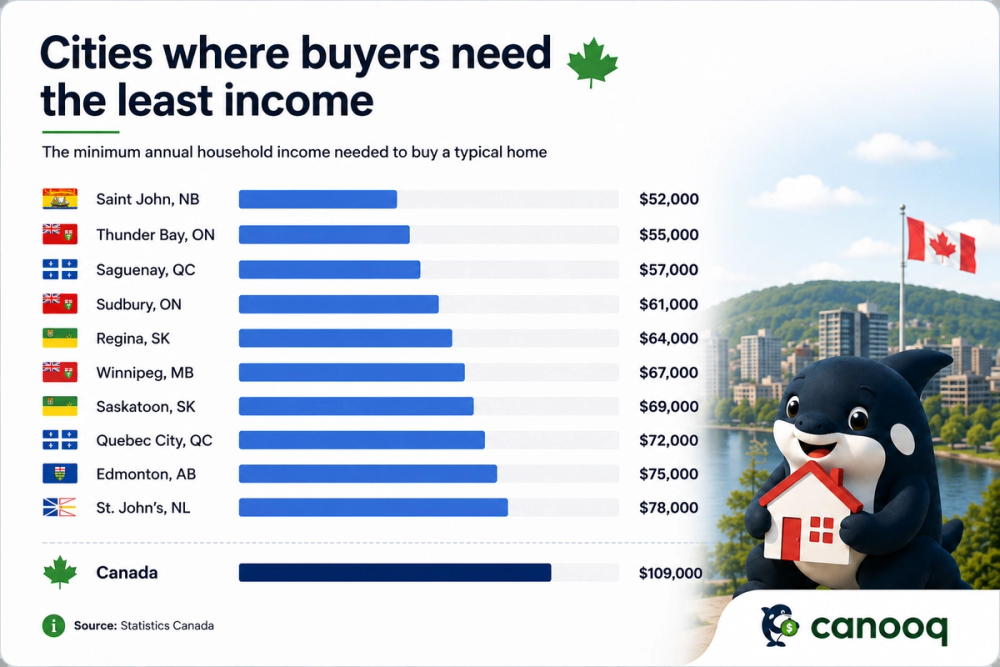
The lowest-income markets in the source chart are mostly smaller or mid-sized cities outside Canada’s highest-priced housing corridors. These are the places where the estimated income needed to buy a median-priced home is well below the national figure.
- Saint John, NB: $52,000
- Thunder Bay, ON: $55,000
- Saguenay, QC: $57,000
- Sudbury, ON: $61,000
- Regina, SK: $64,000
- Winnipeg, MB: $67,000
- Saskatoon, SK: $69,000
- Quebec City, QC: $72,000
- Edmonton, AB: $75,000
- St. John’s, NL: $78,000
- National: $109,000
Saint John has the lowest estimated income requirement in the chart at $52,000, followed by Thunder Bay at $55,000 and Saguenay at $57,000. These numbers are dramatically lower than the national estimate, and they show why some buyers compare smaller-city housing markets when remote work, local employment or lifestyle flexibility make a move realistic.
Prairie cities also stand out. Regina, Winnipeg and Saskatoon all sit below $70,000 in estimated required income, while Edmonton is listed at $75,000. For buyers who want a large city with more affordable housing than Toronto or Vancouver, Edmonton and Winnipeg may be worth comparing carefully. That does not mean buying is automatically better than renting, but the income hurdle can be much lower.
Quebec City and St. John’s also appear in the more affordable group, at $72,000 and $78,000 respectively. These cities can be attractive for buyers who want a lower housing-cost base, but the decision should still include job market, language, transportation, property taxes, insurance, maintenance costs and long-term resale considerations.
Run your own numbers
A city average is only a starting point. Use Canooq’s rent vs buy calculator to compare monthly ownership costs, investment returns, down payment opportunity cost and your own timeline.
Open calculatorWhat the national income number actually means
The national estimate of $109,000 is useful as a benchmark, but it should not be treated as a universal buying rule. Canada does not have one housing market. Vancouver, Toronto, Saint John, Edmonton, Quebec City and Winnipeg are operating with very different home prices, incomes, tax costs, insurance costs and local supply conditions.
A household earning $109,000 may look close to the national estimate, but that same household could be far below the likely requirement in Vancouver or Toronto. It could also be above the estimated requirement in several smaller markets. This is why national affordability headlines can be misleading for real-life decisions. A buyer does not buy the national average. A buyer buys a specific property in a specific city, with a specific lender, at a specific rate, with a specific down payment.
The source chart also uses a 30% housing-cost assumption. That is a helpful affordability rule of thumb, but mortgage underwriting in Canada often uses GDS and TDS ratios, which include different categories of housing and debt costs. CMHC’s debt-service guidance explains that GDS includes housing costs, while TDS includes housing costs plus other debt obligations. The Financial Consumer Agency of Canada’s mortgage qualifier tool also uses 39% GDS and 44% TDS as guideline ratios, while warning that higher ratios increase the risk of taking on more debt than a borrower can afford.
Why two buyers with the same income may qualify for different homes
Income is only one part of mortgage approval. Two households earning the same salary can receive very different mortgage approvals because lenders also look at existing debts, credit history, down payment size, employment stability and property costs. A household with no car loan, no credit-card debt and a large down payment may qualify more comfortably than a household with the same income but higher monthly debt obligations.
The mortgage stress test is another major reason the advertised rate is not the whole story. For uninsured mortgages, OSFI says borrowers must qualify at the greater of the mortgage contract rate plus 2 percentage points or 5.25%. This does not necessarily mean you pay that higher rate, but it means the lender checks whether your finances could handle a higher-rate scenario. The federal government has also described the minimum qualifying rate as a buffer designed to protect buyers from changing economic conditions.
Property type matters too. A condo can have monthly condo fees, and those fees can reduce how much mortgage a buyer qualifies for. A detached house may not have condo fees, but it can come with higher maintenance, insurance, utilities and property taxes. A lower purchase price does not always mean a lower monthly cost if the carrying costs are high.
Most expensive cities for buyers in 2026
Vancouver, BC: estimated income needed of $237,000
Vancouver is the most demanding market in the chart, with an estimated income requirement of $237,000. For many buyers, this makes the first purchase less about stretching for a detached home and more about deciding whether a condo, a smaller unit, a suburb, a longer commute or a bigger down payment is realistic. A high income helps, but the down payment hurdle can be just as important because a 20% down payment on a high-priced property is itself a major savings challenge.
Toronto, ON: estimated income needed of $201,000
Toronto’s estimated income requirement of $201,000 places it second in the chart. The practical issue for many Toronto buyers is that income, down payment and debt load all need to line up at the same time. A strong salary may still not be enough if student loans, car payments, credit-card balances or childcare costs are already using a large share of monthly cash flow.
Victoria, BC: estimated income needed of $169,000
Victoria often feels smaller and calmer than Vancouver or Toronto, but the housing math is still expensive. With an estimated required income of $169,000, buyers need to treat it as a high-cost market. Lifestyle appeal, limited geography and demand from retirees, remote workers and local professionals can all contribute to pressure on prices.
Hamilton, ON: estimated income needed of $148,000
Hamilton is listed at $148,000, which shows how affordability pressure has spread beyond Toronto itself. Buyers who once looked to Hamilton as a cheaper alternative may still find it more accessible than Toronto, but it is no longer a simple bargain market for many households.
Ottawa, ON and Kelowna, BC: estimated income needed of $134,000 and $131,000
Ottawa and Kelowna are close in the chart, at $134,000 and $131,000. Ottawa has a large public-sector and professional employment base, while Kelowna has lifestyle demand and a relatively constrained desirable housing market. In both cities, a buyer should compare ownership costs against renting, especially if they may move again within a few years.
More affordable cities for buyers in 2026
Saint John, NB: estimated income needed of $52,000
Saint John is the most affordable city in the chart, with an estimated required income of $52,000. This number can look surprisingly low to buyers used to Ontario or British Columbia prices, but affordability should still be checked against local wages, job opportunities, property taxes, heating costs and long-term plans.
Thunder Bay, ON and Saguenay, QC: estimated income needed of $55,000 and $57,000
Thunder Bay and Saguenay both come in below $60,000, making them dramatically more accessible on paper than Canada’s largest housing markets. Buyers considering smaller cities should look beyond the mortgage payment and ask whether the local job market, climate, transportation and resale market fit their life.
Regina, SK, Winnipeg, MB and Saskatoon, SK: estimated income needed of $64,000 to $69,000
Regina, Winnipeg and Saskatoon offer some of the most accessible larger-city housing numbers in the chart. With estimated required incomes between $64,000 and $69,000, these cities may appeal to buyers who want urban amenities without Vancouver or Toronto prices. The tradeoff is that buyers still need to consider local economic conditions, property taxes, insurance, maintenance and whether they expect to stay long enough for buying costs to make sense.
Quebec City, QC and Edmonton, AB: estimated income needed of $72,000 and $75,000
Quebec City and Edmonton sit below the national estimate while still offering major-city advantages. Edmonton’s estimated required income of $75,000 is especially notable compared with Calgary’s $111,000, although the right choice between the two depends on work, family, lifestyle and long-term expectations. Quebec City may look very affordable, but language, employment and provincial tax considerations can matter more than the mortgage number alone.
How much income should you personally aim for?
The best way to use these city estimates is as a first filter, not as a final answer. If your target city requires an estimated income of $111,000 and your household earns $95,000, you are not automatically blocked from buying, but you may need a larger down payment, a lower-priced property, fewer debts or a different mortgage structure. If your household earns more than the estimated number, you are not automatically safe either, because your monthly obligations and property-specific costs can still reduce your approval.
A practical buyer should run three versions of the numbers. First, calculate the monthly payment at today’s rate. Second, calculate whether the payment still works if rates are higher at renewal. Third, compare buying against renting and investing the down payment. The opportunity cost of using a large down payment is real. Money used for a home is money that cannot be invested in a TFSA, RRSP or taxable investment account, although the home may also appreciate over time.
This is especially important in expensive markets. In Vancouver or Toronto, the down payment required to avoid mortgage insurance can be large enough to change your entire financial plan. In more affordable cities, the monthly mortgage may be easier to handle, but buyers still need to budget for repairs, legal fees, land transfer tax where applicable, moving costs, insurance, furniture and emergency savings.
Quick takeaways
The estimated national income needed to buy a median-priced home in Canada in 2026 is $109,000, based on the source chart’s assumptions. Vancouver is the highest at $237,000, followed by Toronto at $201,000 and Victoria at $169,000. At the other end, Saint John is the lowest at $52,000, followed by Thunder Bay at $55,000 and Saguenay at $57,000.
The most important lesson is not just that some cities are cheaper than others. It is that the city you choose can completely change the income, down payment and timeline needed to buy. A buyer priced out of one market may still have realistic options elsewhere, while a buyer who looks comfortable on income may still fail a lender’s test if debt payments are too high.
Use the city numbers as a map, then run your own mortgage, rent-versus-buy and cash-flow calculations before making a decision.
Related articles:
Page details
Author: Canooq Editorial
Updated: June 1, 2026
Cite this page: Canooq.ca, How Much Income Do You Need to Buy a Home in Canada in 2026? City-by-City Breakdown, https://canooq.ca/blog/income-needed-buy-home-canada
Canooq content is educational and may include affiliate or referral links. It is not financial, tax, legal, immigration, employment, mortgage, real estate, or healthcare advice. Verify official sources and provider terms before acting.